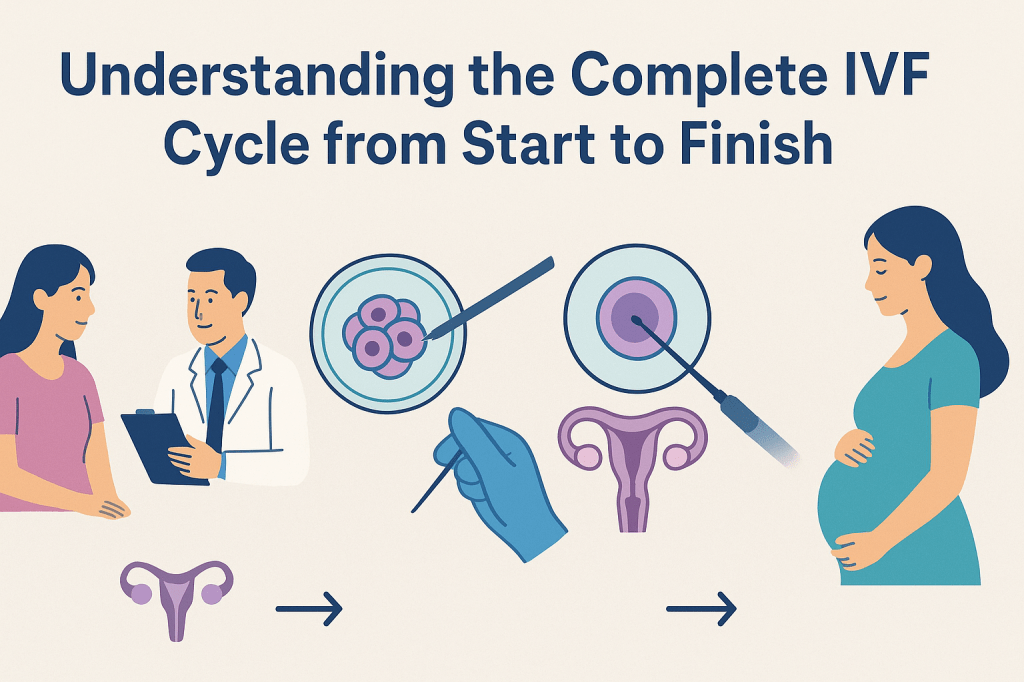
If you’re considering In Vitro Fertilization (IVF) or have recently started your fertility journey, understanding what happens during a complete IVF cycle can help ease your anxiety and prepare you better for the road ahead. This comprehensive guide will walk you through every step of the IVF process in simple, easy-to-understand terms.
What is IVF?
In Vitro Fertilization, commonly known as IVF, is an assisted reproductive technology (ART) where fertilization occurs outside the body. The term “in vitro” means “in glass,” referring to the laboratory dish where eggs and sperm are combined. According to the Centers for Disease Control and Prevention (CDC), IVF is one of the most effective forms of assisted reproductive technology available today.
IVF has helped millions of couples worldwide achieve their dream of parenthood. Whether you’re dealing with blocked fallopian tubes, male factor infertility, endometriosis, unexplained infertility, or age-related fertility issues, IVF offers hope when natural conception becomes challenging.
Before You Begin: The Pre-IVF Phase
Initial Consultation and Evaluation
Your IVF journey begins with a thorough consultation with a fertility specialist. During this visit, your doctor will:
- Review your complete medical history
- Discuss previous pregnancy attempts or losses
- Understand lifestyle factors that might affect fertility
- Perform physical examinations for both partners
Diagnostic Testing
Before starting IVF, several tests help your doctor create a personalized treatment plan:
For Women:
- Ovarian Reserve Testing: Blood tests (AMH, FSH, Estradiol) to assess egg quantity and quality
- Ultrasound: To examine the uterus, ovaries, and antral follicle count
- Uterine Cavity Evaluation: Hysteroscopy or saline sonography to check for abnormalities
- Infectious Disease Screening: Tests for HIV, Hepatitis B and C, and other conditions
For Men:
- Semen Analysis: To evaluate sperm count, motility, and morphology
- Infectious Disease Screening: Similar to women’s testing
The National Institutes of Health (NIH) provides detailed information about various fertility treatments and diagnostic procedures.
The Complete IVF Cycle: Step by Step
Step 1: Ovarian Stimulation (8-14 Days)
Unlike a natural cycle where typically one egg develops, IVF aims to produce multiple eggs to increase success chances. This phase involves:
Medication Protocol:
Your doctor will prescribe injectable hormones to stimulate your ovaries. Common medications include:
- Gonadotropins (FSH and LH) to stimulate egg production
- GnRH agonists or antagonists to prevent premature ovulation
What to Expect:
- Daily injections (your clinic will teach you how to self-administer)
- Regular monitoring visits every 2-3 days
- Blood tests to check hormone levels
- Ultrasounds to monitor follicle growth
During This Phase:
Most women continue their normal activities, though you might experience bloating, mood swings, or breast tenderness. These are normal responses to the medication. Stay hydrated, eat nutritious foods, and get adequate rest.
Step 2: Monitoring and Trigger Shot
Throughout the stimulation phase, your medical team closely monitors your progress through:
- Ultrasound scans: To measure follicle size (ideally 18-20mm before retrieval)
- Blood tests: To measure estradiol levels
When follicles reach the optimal size, you’ll receive a “trigger shot” (usually hCG or Lupron) precisely timed 34-36 hours before egg retrieval. This injection helps eggs mature and prepares them for collection.
Important: The timing of this injection is critical. Set multiple alarms to ensure you don’t miss it!
Step 3: Egg Retrieval (30 Minutes Procedure)
This is a minor surgical procedure performed under sedation or light anesthesia.
The Procedure:
- You’ll arrive at the clinic after fasting
- An anesthesiologist will administer sedation
- Using ultrasound guidance, your doctor inserts a thin needle through the vaginal wall to access the ovaries
- Follicular fluid containing eggs is aspirated from each follicle
- The procedure typically takes 20-30 minutes
Recovery:
- You’ll rest for 1-2 hours in the recovery room
- Mild cramping and spotting are normal
- You’ll need someone to drive you home
- Most women resume normal activities the next day
The embryologist immediately examines the retrieved fluid to identify and count eggs. You’ll typically learn how many eggs were retrieved on the same day.
Step 4: Fertilization (Day 0-1)
Once eggs are retrieved, the fertilization process begins in the laboratory.
Two Methods:
Conventional IVF:
- Eggs and sperm are placed together in a culture dish
- Fertilization occurs naturally over 16-18 hours
Intracytoplasmic Sperm Injection (ICSI):
- A single sperm is directly injected into each mature egg
- Recommended for male factor infertility or previous fertilization failure
On the day after retrieval (Day 1), the embryology team checks for fertilization. They’ll inform you how many eggs fertilized successfully. According to the U.S. Food and Drug Administration (FDA), fertilization typically occurs in 70-85% of mature eggs.
Step 5: Embryo Development (Days 1-6)
The fertilized eggs, now called embryos, are carefully monitored as they develop in specialized incubators that mimic conditions inside the body.
Embryo Development Timeline:
- Day 1: Fertilization confirmed (2 pronuclei visible)
- Day 2: Embryo has 2-4 cells
- Day 3: Embryo has 6-8 cells
- Day 4: Morula stage (cells compacting)
- Day 5-6: Blastocyst stage (inner cell mass and outer layer visible)
Embryo Grading:
Embryologists assess embryos based on:
- Cell number and symmetry
- Fragmentation degree
- Blastocyst expansion and quality (for Day 5-6 embryos)
Many clinics now culture embryos to Day 5-6 (blastocyst stage) before transfer or freezing, as blastocysts have higher implantation potential.
Step 6: Embryo Transfer (15 Minutes Procedure)
This is the moment you’ve been waiting for – when the embryo is placed into your uterus.
Preparation:
- You’ll need a moderately full bladder (helps visualization)
- No sedation is typically required
- Wear comfortable clothing
The Procedure:
- You’ll lie on an examination table similar to a pap smear
- A speculum is inserted into the vagina
- The embryo(s) are loaded into a thin, flexible catheter
- Under ultrasound guidance, the catheter is gently inserted through the cervix
- The embryo is deposited in the optimal uterine location
- The process is generally painless
How Many Embryos?
Your doctor will discuss the number of embryos to transfer based on:
- Your age
- Embryo quality
- Previous IVF attempts
- Risk tolerance for multiple pregnancy
Single embryo transfer is increasingly common to reduce multiple pregnancy risks while maintaining good success rates.
After Transfer:
- Rest for 15-30 minutes
- Resume normal activities (bed rest isn’t necessary and may be counterproductive)
- Avoid heavy lifting, vigorous exercise, and sexual intercourse for a few days
Step 7: The Two-Week Wait
The luteal phase, often called the “two-week wait,” begins after transfer. This is when the embryo hopefully implants into the uterine lining.
Progesterone Support:
You’ll take progesterone supplements (injections, vaginal suppositories, or both) to support the uterine lining and early pregnancy.
What You Might Experience:
- Mild cramping
- Breast tenderness
- Bloating
- Fatigue
- Spotting (which can be normal)
Important Reminders:
- Avoid taking home pregnancy tests too early – they can give false results
- Try to stay busy with work, hobbies, or gentle activities
- Practice stress-reduction techniques like meditation or light yoga
- Avoid alcohol, smoking, and hot baths
This waiting period is emotionally challenging. It’s normal to feel anxious, hopeful, scared, and excited all at once. Lean on your support system and consider joining online IVF communities where others understand your journey.
Step 8: Pregnancy Test (Beta hCG)
Approximately 9-14 days after transfer (depending on embryo stage transferred), you’ll have a blood test to measure hCG (human chorionic gonadotropin) levels.
Understanding Results:
Positive Beta:
- A positive result indicates pregnancy
- The specific number matters – your clinic will look for appropriate levels for days past transfer
- You’ll repeat the test 2-3 days later to ensure levels are rising appropriately (should roughly double every 48-72 hours)
Negative Beta:
- A negative result means the cycle wasn’t successful
- Your doctor will schedule a follow-up consultation to discuss next steps
- Allow yourself time to grieve and process
If positive, you’ll continue progesterone support and have early ultrasounds around 6-7 weeks to confirm heartbeat and pregnancy location.
Additional IVF Procedures You Should Know About
Preimplantation Genetic Testing (PGT)
PGT involves biopsying embryos and analyzing their genetic makeup before transfer. This can help:
- Identify chromosomally normal embryos (PGT-A)
- Screen for specific genetic disorders (PGT-M)
- Detect structural chromosome rearrangements (PGT-SR)
Embryo Freezing (Cryopreservation)
Extra good-quality embryos can be frozen for future use through vitrification (rapid freezing). This allows:
- Future pregnancy attempts without another full IVF cycle
- Embryo banking before cancer treatment
- Delayed transfer if you’re not ready in the current cycle
Frozen Embryo Transfer (FET)
Many clinics now favor “freeze-all” cycles where all embryos are frozen and transferred in a subsequent, non-stimulated cycle. Research suggests FET may have higher success rates in some cases.
IVF Success Rates: What to Expect
Success rates vary significantly based on several factors:
- Age: The most significant factor affecting IVF success
- Embryo quality: Higher-grade embryos have better implantation rates
- Uterine health: A receptive endometrium is crucial
- Clinic expertise: Experienced clinics often have better outcomes
- Diagnosis: Some conditions respond better to IVF than others
According to CDC ART Success Rates data, national averages show that IVF success rates per transfer for women under 35 are approximately 50-60%, declining with age.
Remember: Statistics are helpful but don’t predict your individual outcome. Each person’s fertility journey is unique.
Emotional and Physical Self-Care During IVF
IVF is physically demanding and emotionally exhausting. Here’s how to care for yourself:
Physical Health:
- Maintain a balanced, nutritious diet
- Stay hydrated
- Get moderate exercise (avoid intense workouts during stimulation and after transfer)
- Ensure adequate sleep
- Take prescribed prenatal vitamins
Emotional Wellbeing:
- Acknowledge your feelings – they’re all valid
- Communicate openly with your partner
- Consider fertility counseling or support groups
- Set boundaries with well-meaning friends and family
- Practice stress-management techniques
- Take breaks from fertility-related research and forums when needed
Financial Considerations:
IVF can be expensive. Discuss costs upfront, explore insurance coverage, consider financing options, and ask about medication assistance programs.
When to Consider IVF
The American Society for Reproductive Medicine (ASRM) suggests considering IVF for:
- Blocked or damaged fallopian tubes
- Male factor infertility
- Ovulation disorders
- Endometriosis
- Uterine fibroids
- Previous tubal ligation or removal
- Genetic disorders
- Unexplained infertility
- Age-related fertility decline
- Preservation of fertility before cancer treatment
Questions to Ask Your Fertility Specialist
Before starting IVF, prepare questions such as:
- What are my specific chances of success based on my diagnosis?
- What stimulation protocol do you recommend and why?
- How many embryos should we transfer?
- Should we consider genetic testing of embryos?
- What’s your approach if this cycle doesn’t work?
- What are the risks and potential complications?
- What’s included in the quoted IVF cost?
Final Thoughts
Understanding the complete IVF cycle from start to finish empowers you to make informed decisions and know what to expect at each stage. While the process can feel overwhelming, remember that millions of families have successfully navigated this journey, and advances in reproductive medicine continue to improve outcomes.
Every person’s fertility story is different. What works for one couple may not work for another. Stay patient with yourself, advocate for your needs, trust your medical team, and maintain hope while staying realistic about outcomes.
Whether this is your first cycle or you’re a veteran of fertility treatments, knowledge is power. The IVF journey requires courage, resilience, and patience – qualities you’ve already demonstrated by taking this step toward building your family.
Useful Resources
Finding reliable information and experienced specialists can make a significant difference in your IVF journey. Here are some helpful resources to support you:
Trusted Government and Medical Resources
- CDC – Assisted Reproductive Technology: Comprehensive data on ART success rates and fertility clinic information
- NIH – Infertility and Fertility: Research-backed information on infertility treatments
- FDA – Infertility Resources: Important safety and regulation information about fertility treatments
- ASRM – Reproductive Facts: Patient education resources from fertility specialists
Special Thanks
Acknowledgment
This article has been developed with the help of expert discussions held with teams from Urvara Fertility Centre, Lucknow, and Thakral IVF Centre, Gurgaon. Their medical perspectives and factual inputs played an important role in shaping the clarity and usefulness of this content.
Urvara Fertility Centre, Lucknow
The specialists at Urvara contributed important insights related to fertility treatments and reproductive care. The centre is widely known for its work in assisted reproduction and evidence-based guidance. It also serves patients seeking dependable fertility support in the region, being regarded among the best IVF centres in Lucknow for comprehensive services such as IVF, ICSI, embryo freezing, and fertility preservation.
Thakral Hospital & Fertility Centre, Gurgaon
The medical team at Thakral shared valuable information on women’s health, labour management, gynecological care, and fertility protocols. The hospital’s experience across maternity and reproductive health makes it a key reference point for many families in the area. It is also frequently consulted by individuals searching for reliable maternity and fertility services, such as:
Support from an established IVF centre in Gurgaon
Guidance at a Maternity hospital in Gurgaon
Facilities associated with the Best hospital in Gurgaon for delivery
Expert consultation at a Best Gynecologist hospital in Gurgaon
 Health Mania
Leave a comment